A clearer plan for your Kansas City foundation.
Read the signs, compare repair approaches and check the rules for your side of the state line.
01 · Visible observations
Start with the signs you can describe
Separate the visible pattern, its possible explanation and the proposed work. Choose a topic to prepare your questions.
Showing all eight observation topics.
Cracks in brick or mortar
Record the visible pattern, its location and when you first noticed a change.
Read the guideUneven or sloping floors
Bring previous measurements and note the affected rooms or doors.
Read the guideBasement wall movement
Ask which wall and supports are being assessed, and what remains uncertain.
Read the guideWater near the foundation
Record where water collects and what you observed before it appeared.
Read the guideWall or floor seepage
Identify the entry location and ask how the proposed work addresses that path.
Read the guideSump system questions
Keep equipment records and ask for an explanation of any proposed change.
Read the guideCondensation or dampness
Separate observed damp surfaces from an assumption about the water source.
Read the guideWater through a drain
Ask the appropriate provider which drain or sewer connection needs investigation.
Read the guideThis is a guide to useful observations and questions. A visible symptom does not, by itself, establish the cause or the appropriate repair.
02 · Assessment preparation
A three-step path to a clearer proposal
Record what you see
Keep the location, date and changes you have noticed together with earlier reports and photographs.
Organize your observationsUnderstand the cause & scope
Ask what was measured, which explanation the evidence supports and what still needs investigation.
Prepare assessment questionsCompare the written work
Compare the proposed locations, responsibilities, exclusions and completion records alongside the price.
Use the project checklist03 · Local evidence with jurisdiction limits
One metro. Different sources and scopes.
Kansas City, Missouri housing data and Kansas-side foundation guidance belong in separate categories. Keep the actual project address at the center of the decision.
2020–2024 ACS estimate. It does not represent the whole metro or count homes needing repairs.
Original Census context →Share of occupied housing units in the 2020–2024 ACS. Not a measure of foundation condition.
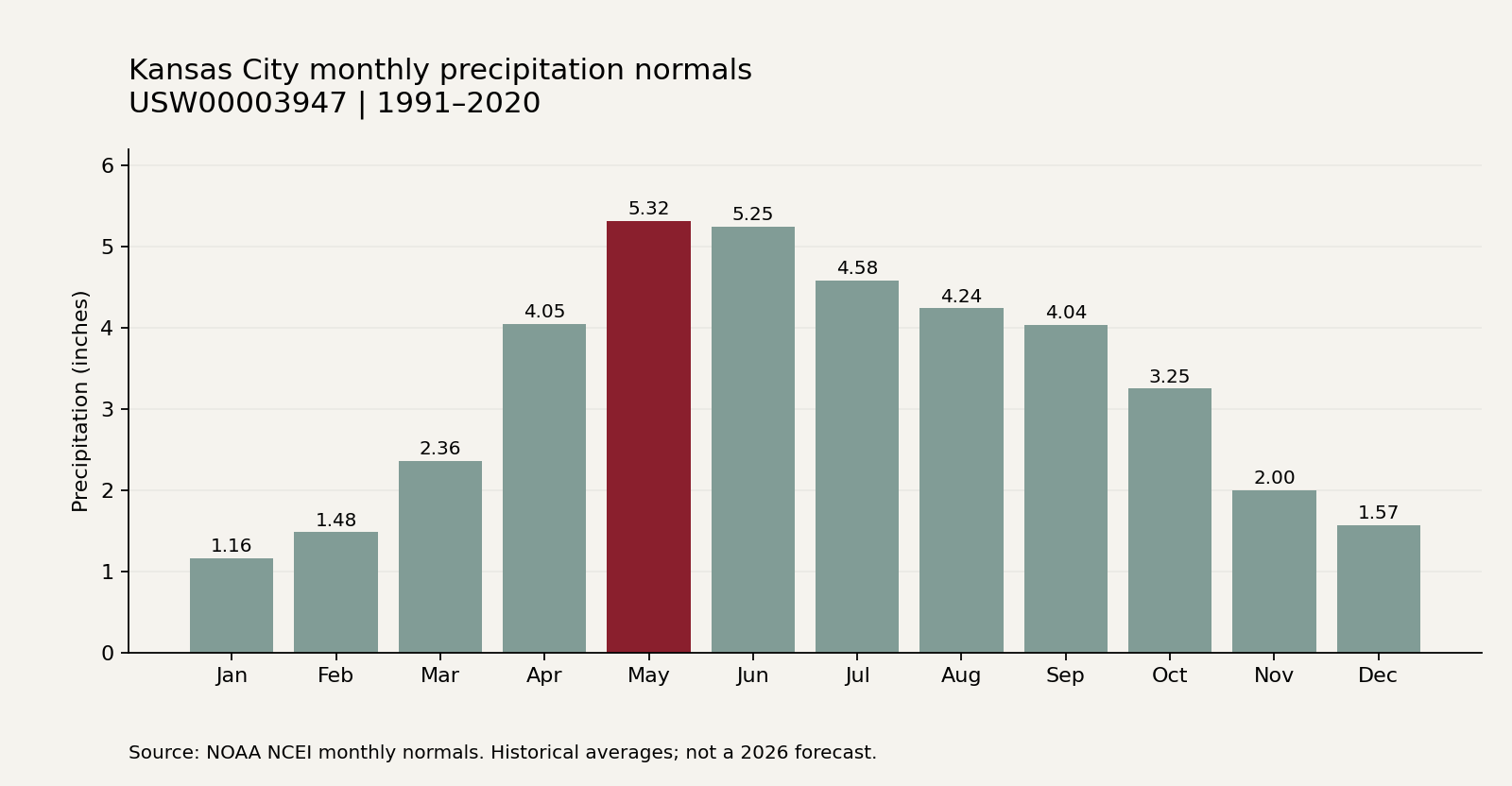
Check the denominator →1991–2020 at Kansas City International Airport, USW00003947. Not 2026 rainfall.
NOAA source and period →Minimum in the guideline labeled 2020, subject to its scope and the actual jurisdiction. Not a metro-wide rule.
Read the guidance limits →Before applying a rule: identify the municipality, county and state for the property. Confirm the current requirements for the proposed work with the responsible authority.
04 · Homeowner preparation
Before you book an assessment
Bring enough context for a useful conversation. Ask which questions the visit will answer and what the written deliverable will include.
Open the checklist →Locate the project precisely
Record the municipality, county and state. A Kansas City mailing address does not substitute for confirming the responsible jurisdiction.
Bring the existing record
Gather photographs, previous reports and records of repairs or drainage changes. Keep observations separate from earlier assumptions about the cause.
Ask how the scope was chosen
Ask what supports the proposed work and whether any site condition falls outside the assumptions in a standard detail.
Kansas City foundation statistics & local context
Housing estimates, station weather normals and separately labeled Johnson County guidance—with original sources and reproducible arithmetic.
05 · Foundation vocabulary
Know the terms
Five definitions with local examples and primary sources. Read the full entry before applying a term to a property.
Plasticity Index
The difference between a soil sample’s liquid limit and plastic limit.
Read the guideExpansive Soil
Soil that can change volume substantially as its moisture content changes.
Read the guideDifferential Settlement
Unequal downward movement between parts of a structure’s support.
Read the guideFrost Depth
The depth of ground freezing, or a jurisdiction’s stated design criterion.
Read the guide06 · Editorial responsibility
Methodology, authorship & clear limits
Stateline Level explains public evidence with source links, original dates and a named publisher. Guidance from one side of the state line is not presented as a rule for the other.
Publisher: Arthur Smelyansky
Read the editorial method →Source publications: U.S. Census Bureau · NOAA climate normals